Introducing Vital Folinic with 5-MTHF™

The human brain is an extraordinary organ — remarkably resilient yet metabolically demanding. When pathways that support optimal neuronal metabolism and immune regulation become strained, symptoms such as difficulty concentrating, word-finding challenges, short-term memory lapses, and persistent fatigue — often described as brain fog — may arise. Folinic acid has been studied for its potential role in supporting cognitive function. These cognitive challenges have been observed across a range of clinical conditions characterized by localized neuroinflammation and metabolic stress, including neurodegenerative disorders, post-infectious syndromes, and complex chronic conditions; autism spectrum disorder (ASD), Long COVID syndrome, Mast cell activation disorders (MCADs), mild cognitive impairment (MCI) and Myalgic encephalomyelitis/chronic fatigue syndrome (ME/CFS).
Supporting the biochemical pathways that nourish and protect neuronal function is a key strategy for promoting cognitive resilience and neurological health.
One of the most foundational nutrients for brain metabolism is vitamin B9 (folate), an essential cofactor in one-carbon metabolism, DNA synthesis and repair, methylation reactions, and neurotransmitter production. Methylation — the transfer of methyl groups (–CH₃) — influences gene expression, neurotransmitter synthesis, and cellular detoxification. Optimal folate status is therefore indispensable for energy metabolism and cognitive function.

Why Folate Biology Matters
- Not all forms of vitamin B9 are created equal.
- The vitamin exists in several distinct chemical forms — each with unique metabolic properties:
- Dietary folate, naturally occurring in foods such as leafy greens and legumes.
- Folic acid, the synthetic precursor used in fortified foods and many supplements.
- Methylfolate (5-MTHF), the biologically active methylated form.
- Folinic acid (calcium folinate/Leucovorin), a metabolically accessible intermediate.
However, these terms indicate distinct forms of B9 that differ in their chemical structures, bioavailability, and how they are metabolized in the body.
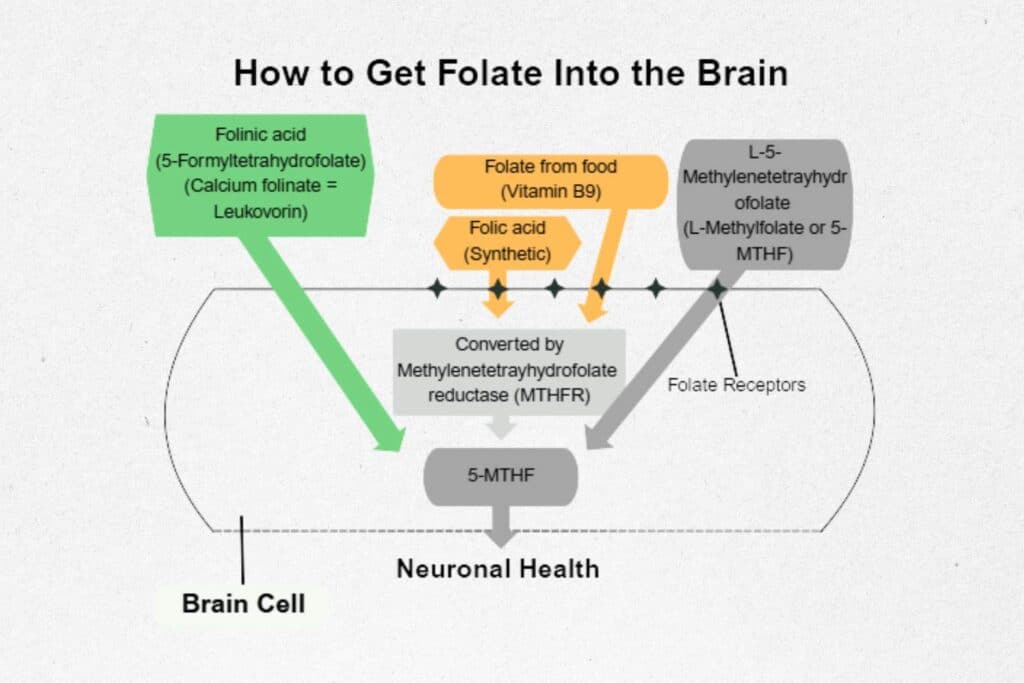
Folate is the natural water-soluble form of vitamin B9 found in leafy green vegetables, legumes, eggs, and citrus fruits. Folate is essential for DNA synthesis, repair and methylation, as well as red blood cell formation. All brain cells, especially neurons, require vitamin B9 for their overall health. This is the form we consume through eating natural foods, but it is degraded via various cooking processes. Additionally, it must be converted to its active form, methylfolate, by the enzyme MTHFR. However, there are a number of potentially stumbling blocks (see figure below) because folate:
- Must enter the cells by binding to specialized surface receptors. About 2-3% of children and as many as 10-15% of adults have folate receptor autoantibodies (FRAA). However, in certain populations like children with Autism Spectrum Disorder (ASD) or Cerebral Folate Deficiency, the number of individuals with FRAA is as high as 60%.
- Must be converted into active forms (e.g., methylfolate) by the enzyme methylenetetrahydrofolate reductase (MTHFR). A significant portion of the population is heterozygous carrying gene polymorphisms for either the C677T or A1298C MTHFR variant. However, roughly 40% of Caucasians and Hispanics are carriers (heterozygous) of the most common C677T variant and 8-20% are homozygous for two copies, severely impacting enzyme function.
- The enzyme MTHFR requires methyl groups to produce methylfolate and as many as 40% of individuals have difficulty absorbing or utilizing methyl groups.
Folic acid is the synthetic form of vitamin B9, commonly used in dietary supplements and fortified foods. In fact, in the United States, folic acid is readily found in your food supply after a government mandate, aimed at reducing neural tube defects, initiated folic acid fortification of various breads, cereals, and pastas. Folic acid is a fully oxidized, stable compound that does not occur naturally in foods. It is more bioavailable than natural folate because it is easily absorbed. However, it must still enter the cells and be converted into its active form methylfolate, thus requiring all the three steps outlined above.
Methylfolate (5-Methyltetrahydrofolate, 5-MTHF): The Active Form
Methylfolate is the active form of folate circulating in the body and the form directly used in methylation reactions vital for homocysteine metabolism, neurotransmitter synthesis, and cellular methylation pathways (see figure below). Because it bypasses the need for enzymatic conversion by MTHFR (methylenetetrahydrofolate reductase), 5-MTHF is especially beneficial in supporting individuals who may carry MTHFR variants that impair folate metabolism.
Folinic Acid (5-formyltetrahydrofolate): A Metabolically Versatile Form
Folinic acid is a reduced form of folate that enters cellular folate pools without needing initial conversion by dihydrofolate reductase, unlike folic acid. It feeds into the folate cycle at a point that can support endogenous production of 5-MTHF and other folate cofactors, helping to sustain one-carbon metabolism even when some metabolic steps are compromised (see figure above).
“Together, these forms of folate support the full spectrum of folate metabolism — from cellular uptake to methylation.“
Dr. Theoharides
Introducing Vital Folinic with 5-MTHF™
Vital Folinic with 5-MTHF™ is a liquid dietary supplement specifically engineered to support healthy folate pathways essential for neurological health, cognitive development, and metabolic resilience — with a formulation that addresses common metabolic and transport challenges associated with standard synthetic folic acid supplementation.

How Vital Folinic with 5-MTHF™ Enhances Folate Function
The body’s ability to use folate effectively depends on multiple steps — from absorption and receptor-mediated transport to intracellular conversion and methylation reactions. Traditional folic acid supplements rely heavily on enzymatic conversion, which may be inefficient in individuals with specific genetic variants or biochemical limitations. By providing both folinic acid and 5-MTHF:
- Folinic Acid (Calcium Folinate/Leucovorin) — a bioaccessible folate intermediate that supports cellular folate pools without requiring reduction by dihydrofolate reductase.
- 5-MTHF (L-5-Methylfolate) — the active, methylated form of folate that enters methylation cycles directly.
By including both forms, Vital Folinic with 5-MTHF™ helps bridge potential metabolic bottlenecks — from cellular uptake and transport to methyl group availability — offering a more flexible folate support system than products containing only a single form of B9. This dual strategy helps ensure that key folate-dependent processes supporting neuronal health and cognitive function are sustained, even in the face of metabolic variability.

Clinical and Practical Advantages
- Supports neurological and cognitive function: Folate is essential for one-carbon metabolism, neurotransmitter synthesis, and homocysteine regulation — all of which influence brain health.
- Addresses metabolic variability: By combining folinic acid and 5-MTHF, the formula supports individuals who may have difficulty metabolizing synthetic folic acid or who carry common enzyme variants.
- Liquid delivery for precise titration: The liquid format enables careful dose adjustments, which can be particularly helpful for sensitive populations including children and individuals with complex metabolic profiles.
Conclusion: A Comprehensive Approach to Brain Health
Vital Folinic with 5-MTHF™ represents a thoughtful evolution in folate supplementation — one that leverages the metabolic strengths of both folinic acid and methylfolate. By supporting cellular uptake, metabolic activation, and direct methylation pathways, this formulation offers a comprehensive tool for individuals seeking to optimize neurological function and metabolic health.
Many recent publications have provided evidence that the use of either folinic acid and/or methylfolate can help improve at least language development in children with ASD.
For those looking to support cognitive resilience, brain energy and brain health, Vital Folinic with 5-MTHF™ delivers a scientifically grounded, clinically relevant approach.
References:
Giorlandino C, Margiotti K, Fabiani M, Mesoraca A, D’Emidio L, Raffio R, Coco C, Mastrandrea ML, Pasquale C, Cupellaro M, Giorlandino F, Pignataro F, Milite V. Maternal Folate Receptor Alpha Autoantibodies and Increased Fetal Nuchal Translucency as Potential Early Markers of Autism Spectrum Disorder. Brain Behav. 2025 Nov;15(11):e71088.
Zhang C, Chen Y, Hou F, Li Y, Wang W, Guo L, Zhang C, Li L, Lu C. Safety and Efficacy of High-Dose Folinic Acid in Children with Autism: The Impact of Folate Metabolism Gene Polymorphisms. Nutrients. 2025 May 7;17(9):1602.
Wong CM, Tan CS, Koh HC, Gan X, Hie SL, Saffari SE, Yeo JG, Lam JCM. Folinic acid as a treatment for autism in children: A within-subjects open-label study on safety and efficacy. Int JDev Neurosci. 2025 Feb;85(1):e10402.
Panda PK, Sharawat IK, Saha S, Gupta D, Palayullakandi A, Meena K. Efficacy of oral folinic acid supplementation in children with autism spectrum disorder: a randomized double-blind, placebo-controlled trial. Eur J Pediatr. 2024 Nov;183(11):4827-4835.
Wells L, O’Hara N, Frye RE, Hullavard N, Smith E. Folate Receptor Alpha Autoantibodies in the Pediatric Acute-Onset Neuropsychiatric Syndrome (PANS) and Pediatric Autoimmune Neuropsychiatric Disorders Associated with Streptococcal Infections (PANDAS) Population. J Pers Med. 2024 Jan 31;14(2):166.
Frye RE, Lane A, Worner A, Werner BA, McCarty PJ, Scheck AC, Collins HL, Adelman SJ, Quadros EV, Rossignol DA. The Soluble Folate Receptor in Autism Spectrum Disorder: Relation to Autism Severity and Leucovorin Treatment. J Pers Med. 2022 Dec 8;12(12):2033. D
Phunsawat P, Chiangjong W, Chutipongtanate S, Dumrongwongsiri O, Thommachot P, Butdawong W, Chuthapisith J. Folate receptor alpha autoantibodies in children with autism spectrum disorder. Biomarkers. 2022 Dec;27(8):715-719.
Rossignol DA, Frye RE. Cerebral Folate Deficiency, Folate Receptor Alpha Autoantibodies and Leucovorin (Folinic Acid) Treatment in Autism Spectrum Disorders: A Systematic Review and Meta-Analysis. J Pers Med. 2021 Nov 3;11(11):1141. doi: 10.3390/jpm11111141. Erratum in: JPers Med. 2022 Apr 29;12(5):721.
Frye RE, Slattery J, Delhey L, Furgerson B, Strickland T, Tippett M, Sailey A, Wynne R, Rose S, Melnyk S, Jill James S, Sequeira JM, Quadros EV. Folinic acid improves verbal communication in children with autism and language impairment: a randomized double-blind placebo-controlled trial. Mol Psychiatry. 2018 Feb;23(2):247-256.
Frye RE, Delhey L, Slattery J, Tippett M, Wynne R, Rose S, Kahler SG, Bennuri SC, Melnyk S, Sequeira JM, Quadros E. Blocking and Binding Folate Receptor Alpha Autoantibodies Identify Novel Autism Spectrum Disorder Subgroups. Front Neurosci. 2016 Mar 9;10:80.
Li CX, Liu YG, Che YP, Ou JL, Ruan WC, Yu YL, Li HF. Association Between MTHFR C677T Polymorphism and Susceptibility to Autism Spectrum Disorders: A Meta-Analysis in Chinese Han Population. Front Pediatr. 2021 Mar 10;9:598805.
Zhang J, Ma X, Su Y, Wang L, Shang S, Yue W. Association Study of MTHFR C677T Polymorphism and Birth Body Mass With Risk of Autism in Chinese Han Population. Front Psychiatry. 2021 Feb 25;12:560948.
Li Y, Qiu S, Shi J, Guo Y, Li Z, Cheng Y, Liu Y. Association between MTHFR C677T/A1298Cand susceptibility to autism spectrum disorders: a meta-analysis. BMC Pediatr. 2020 Sep 24;20(1):449.
Sadeghiyeh T, Dastgheib SA, Mirzaee-Khoramabadi K, Morovati-Sharifabad M, Akbarian-Bafghi MJ, Poursharif Z, Mirjalili SR, Neamatzadeh H. Association of MTHFR 677C>T and 1298A>C polymorphisms with susceptibility to autism: A systematic review and meta-analysis. Asian J Psychiatr. 2019 Dec;46:54-61.
Ismail S, Senna AA, Behiry EG, Ashaat EA, Zaki MS, Ashaat NA, Salah DM. Study of C677T variant of methylene tetrahydrofolate reductase gene in autistic spectrum disorder Egyptian children. Am J Med Genet B Neuropsychiatr Genet. 2019 Jul;180(5):305-309.